


New Income Tax Act 2025 and Income Tax Rules 2026: What Changes for You
- Updated On:25 Apr 2026
 Views
Views- 7 min read
https://www.shriramlife.com/blog/advice/new-income-tax-act-rules


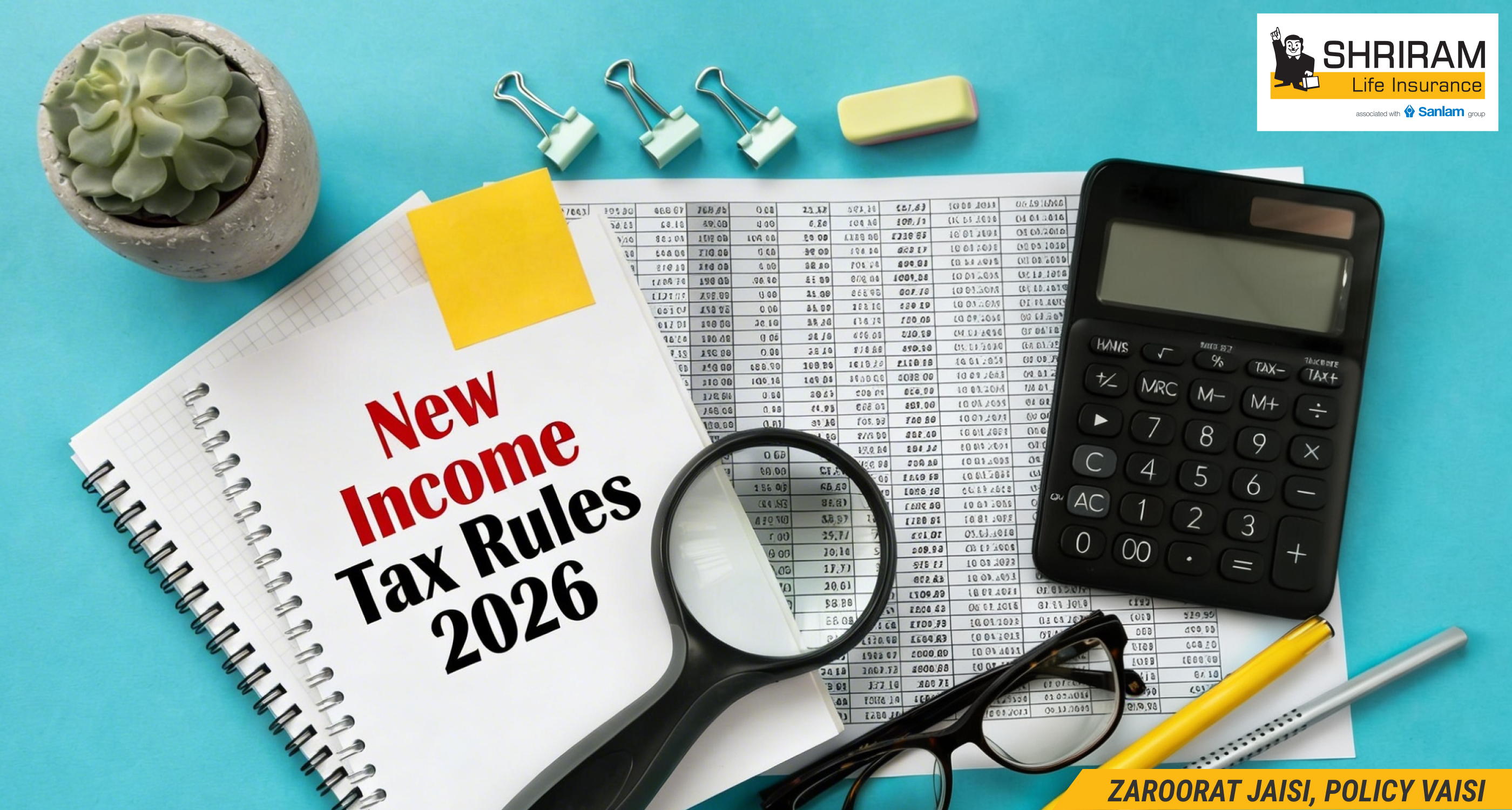
April 1, 2026 came and went like any other day for most people. But if you pay income tax in India, that date changed quite a bit.
Two things happened on the same date. The Income Tax Act, 1961 — patched and amended across 65 years and 819 sections — was replaced by the Income Tax Act, 2025. And the old Income Tax Rules, 1962 went with it, replaced by the Income Tax Rules, 2026. Together, they rewrote how crores of salaried employees, retirees, small business owners, and individual taxpayers file and pay their taxes.
Read this once, properly. By the end you'll have a clear picture of what changed, what didn't, and what you actually need to do.
What Are the Changes, Exactly?
Think of it this way. The Income Tax Act is the law — it says what’s taxable, what’s exempt, what the slabs are. The Rules handle the operational detail: which form to submit, what documents to keep, how allowances get calculated. The new Income Tax Rules, 2026 were issued by the CBDT in March 2026 alongside the new Act. Both came into effect April 1.
The old rules had 511 provisions accumulated over six decades of amendments and patches. New ones: 333. That's a 35 per cent cut. The stated intent is to simplify, reduce duplication, and remove the grey areas that generate disputes. Whether it fully delivers on that will play out over time — but structurally, it's a significant cleanup.
Most taxpayers will at least welcome the intention.
📊 A Number Worth Knowing: 511 → 333 The CBDT's March 2026 notification reduced India's income tax compliance rules from 511 to 333 — the first comprehensive overhaul since 1962. For individual taxpayers, this mostly means cleaner forms and updated allowance limits. For professionals and businesses, it means every Section reference in software, advisories, and court filings has changed. |
Five Things That Actually Changed from April 1, 2026
Enough overview. Here's what actually changed — and who it affects.
1. 'Tax Year' Replaces 'Previous Year' and 'Assessment Year'
This one sounds small but it genuinely confused people — including some experienced filers, honestly. Under the old system, you earned income in the 'Previous Year' but the tax was levied in the 'Assessment Year.' Two different names for what was effectively the same 12-month period. Ask ten people what Assessment Year 2027-28 means and watch the hesitation.
Under the new Act, both are gone. Just one term: Tax Year. Income earned in Tax Year 2026-27 (April 2026 to March 2027) gets reported and assessed with the same name unlike Assessment Year earlier. Your salary TDS certificate — now Form 130 instead of Form 16 — will say Tax Year 2026-27. Simple.
Should have happened years ago, frankly.
2. Four More Cities Get 50 Per Cent HRA Exemption
If you're renting in Bengaluru, Pune, Hyderabad, or Ahmedabad — this one's for you. These four cities have been moved into the 50 per cent HRA exemption bracket. Earlier they were at 40 per cent. Now they're alongside Delhi, Mumbai, Chennai, and Kolkata. Eight cities total at the higher rate.
Previously at 40 per cent. What does jumping to 50 per cent actually mean in rupees? For someone in Bengaluru with a Rs.60,000 monthly basic paying Rs.35,000 in rent, it adds Rs.60,000 in exempt HRA annually. Keep rent receipts, get your landlord's PAN if rent crosses Rs 1 lakh a year, hold the rental agreement. Old regime only.
3. Meal Vouchers, Gift Cards, and Education Allowances — All Revised Upward
The revised allowance limits under the new rules are genuinely more in line with current costs. Meal vouchers are now tax-free up to Rs 200 per meal (up to 2 meals a day, so Rs 400 per working day), revised from Rs 50 per meal under the old rules — a fourfold increase. Children’s education allowance has jumped from Rs 100 to Rs 3,000 per month per child (for up to 2 children), and hostel allowance from Rs 300 to Rs 9,000 per month per child.
Gift from employer is tax free up to Rs.15000 which Rs.5000 under old rules. Transport allowance for differently-abled employees has also been revised upward — to Rs 15,000 per month plus DA in metro cities and Rs 8,000 per month plus DA in other cities, up from Rs 3,200 per month. These are meaningful numbers, not cosmetic tweaks — especially for employees structuring salary components under the old regime.
4. New Filing Deadlines — One Extension That Matters
August 31 for ITR-3 and ITR-4 non-audit. October 31 for audit cases. ITR-1 and ITR-2 salaried filers — July 31 as always. Made a mistake after filing? You have until March 31 of next year to correct it. Three months more than before.
Salaried individuals on ITR-1 or ITR-2 — you're still on July 31. Audit cases remain October 31, no change there.
But honestly, the more useful change is this one — the window to file a revised return has been stretched from nine months to twelve months from the end of the Tax Year. Made a mistake in your July filing? You now have until March 31 of next year to correct it. Under the old system, the deadline would have been December 31. Three extra months. Quietly, this is one of the more taxpayer-friendly changes in the whole overhaul.
5. New Form Names — And You Need to Know Them
Every major form has a new number. This matters more than it sounds — your payroll team, bank, and CA are all working off these names now. The ones you’ll actually encounter: Form 16 (salary TDS certificate) is now Form 130. Form 16A (TDS for non-salary income) is now Form 131.
Form 26AS is now Form 168. Forms 15G and 15H have been merged into one — Form 121. Form 12BB, which salaried employees submit to their employer for HRA, home loan, and 80C (Now Section 123 read with schedule XV) deductions, is now Form 124. Form 60 (no-PAN declaration) is now Form 97.
Old form numbers will create mismatches. Verify with your employer and bank that they've switched over before you file.
6. What the New Income Tax Rules 2026 Mean Specifically for Salaried Employees?
For salaried employees, the new income tax rules 2026 bring changes that show up directly in your pay slip, your investment declaration, and the documents your HR team collects every April. The most immediate shift: your deduction declaration — earlier submitted on Form 12BB — is now Form 124, and your TDS certificate has moved from Form 16 to Form 130 (From FY 2026–27 onwards, to be received in June 2027). If your employer is still using the old form names, flag it early; mismatches can delay processing.
On the deductions side, Section 80C survives under the old regime but now sits under Section 123 read with Schedule XV of the Income Tax Act, 2025 — the limit stays at ₹1.5 lakh, but your CA's software may show a different section number.
Employees in Bengaluru, Hyderabad, Pune, and Ahmedabad get a meaningful HRA upgrade — the exemption ceiling moves from 40% to 50% of basic salary, which can add ₹40,000–₹80,000 per year in tax-free income depending on your rent and salary band.
And if you receive meal vouchers or a children's education allowance from your employer, the revised limits are substantially higher — meal vouchers now exempt up to ₹200 per meal (up from ₹50), and the children's education allowance jumps from ₹100 to ₹3,000 per month per child.
The regime choice itself — old or new — remains yours to make, but the new rules change the math enough that it's worth revisiting your numbers before the next declaration cycle.
⚠️ Don't Let This Trip You Up Many payroll software systems and tax portals were slow to update to the new form names after April 1. Before you file or submit anything, confirm with your employer that Form 130 has been issued (not the old Form 16), and that your deduction declaration has been collected on Form 124 (not the old Form 12BB). Ask your bank for Form 121 if you need to declare nil taxable income. Old form references may be rejected or cause mismatches in processing. |
Filing Under the New Rules: What the Process Looks Like Now
Done this before? There are still a few things that catch experienced filers off guard this year.
- Your Tax Year is 2026-27 — April 2026 to March 2027. No separate 'Assessment Year 2027-28' label. One period, one name.
- Get your updated documents. Form 130 is your new Form 16. Deduction declarations you submitted to your employer on Form 12BB are now Form 124. TDS exemption for FD interest? Ask your bank for Form 121 — the merged version of old 15G and 15H. And Form 168 replaces Form 26AS as your annual tax statement.
- Made a mistake? You have until March 31, 2028 to file a revised return for Tax Year 2026-27. Previously the window would have closed in December 2027. Three extra months — use them if you need to.
The Bottom Line
April 2026 brought more change to India's tax system than the previous ten years put together. The law is cleaner. There's less paperwork. But the decisions taxpayers now have to make — especially the regime choice — carry more weight.
DISCLAIMER
This article is for general informational purposes only and does not constitute tax, legal, or financial advice. Tax laws are subject to change. Consult a qualified Chartered Accountant or financial advisor before making decisions on tax regime selection, insurance purchases, or investment products. Tax benefits are subject to conditions under applicable income tax laws and may change. Shriram Life Insurance Company Limited. IRDAI Regn. No. 128. CIN: U66010TG2005PLC045616
FAQs
More than you'd think. Forms have new numbers — Form 16 is Form 130, deduction declaration Form 12BB is Form 124. HRA is now 50 per cent in Bengaluru, Pune, Hyderabad, and Ahmedabad (up from 40 per cent).
Allowances substantially revised — meal vouchers from Rs 50 to Rs 200 per meal, children's education allowance from Rs 100 to Rs 3,000 per month per child and hostel allowance from Rs.300 to Rs.9,000 per month per child. Transport allowance for differently-abled employees also up. Tax rates? Unchanged. Old regime deductions? Intact.
No. Slab rates are exactly the same for FY 2026-27 under both regimes. What changed is the compliance layer — forms, allowance limits, section numbers, and the structural shift from the 1961 Act to the new 2025 Act. The rates themselves were not touched.
Yes, the option remain intact.
Yes — if you're in the old regime, but section number changes from 80C to Section 123 read with Schedule XV PPF, ELSS, and all qualifying investments still count toward the Rs 1.5 lakh deduction. Switch to the new regime and Section 80C is off the table entirely.
Under the old Act, you earned income in the 'Previous Year' and got taxed in the 'Assessment Year' — two labels for one 12-month period. Under the new Act, both gone. Just: Tax Year. Income earned in Tax Year 2026-27 (April 2026 to March 2027) gets filed and assessed with same name unlike Assessment Year earlier.
Both are now Form 121 — merged into one. They were doing the same job anyway: declaring to a bank that your income is below the taxable limit so TDS doesn't get cut from interest. Form 121 does the same. Ask your bank for it.
August 31 for ITR-3 and ITR-4 non-audit. October 31, 2027 for audit cases. ITR-1 and ITR-2 salaried filers — July 31, 2027. Made a mistake after filing? You have until March 31, 2028 to fix it. Three months more than before.
They were at 40 per cent. Now they're at 50 per cent, alongside Delhi, Mumbai, Chennai, and Kolkata. A Bengaluru employee on Rs 60,000 monthly basic paying Rs.35,000 rent adds roughly Rs.60,000 in exempt HRA per year. Old regime only.
Plans worth exploring
 Shriram Life Flexi-Shield Plan
Comprehensive Protection

Shriram Life Flexi-Shield Plan  Shriram Life Sunishchit Laabh
Secure your family's future
Shriram Life Sunishchit Laabh  Shriram Life Wealth Pro Plan
Strong Returns, Steady Protection
Shriram Life Wealth Pro Plan
Why Shriram Life
Experience
Lives covered
Claims Settled (FY 2025-26)
Explore more topics
Trending searches
Find the right plan for you
OTP Verification
Please Enter OTP that has been sent to your registered
Mobile Number +91





Get a call Back to Plan Your Life Insurance
OTP Verification
Please Enter OTP that has been sent to your registered
Mobile Number +91

We’ve Got Your Details
You’re one step closer to securing a guaranteed income. Our team will contact you soon.


