


TDS on Salary 2026-27: Meaning, Calculation, Rates & How to Claim a Refund
- Updated On:15 May 2026
 Views
Views- 8 min read
https://www.shriramlife.com/blog/advice/what-is-tds-in-salary-india


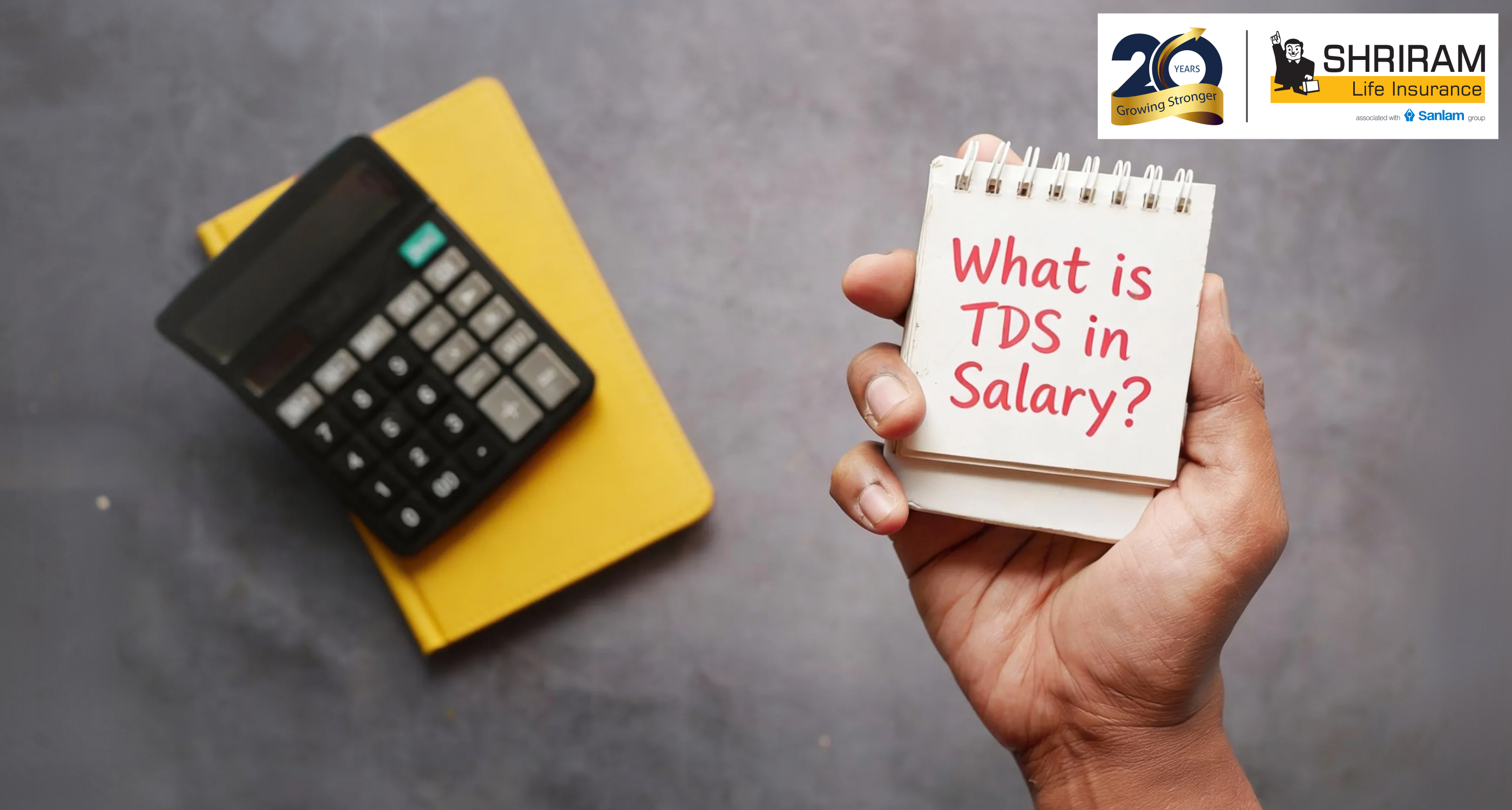
Open your salary slip for this month.
Somewhere in the deductions column, there is a line that says TDS. It could be ₹4,000. It could be ₹22,000. Either way, it is money that left your account before you even saw it — and a surprising number of salaried Indians have no idea whether the amount is correct.
Your employer may not always get the calculation right. And if excess TDS is deducted, that is your money sitting with the government, waiting for you to claim it back.
This article covers what TDS on salary actually means, how the calculation works month by month, how FY 2026-27 changes things under the new tax regime, and the exact steps to get a refund when you are owed one.
BEFORE YOU READ — 5 THINGS THAT MATTER 1. Section 192 of the Income Tax Act, 1961 is what governs TDS on salary. From April 2026, the same obligation sits under Section 392 of the new Income Tax Act, 2025. 2. Not a flat percentage. Your employer calculates TDS based on your estimated annual income and the applicable slab — which is why two colleagues on different salaries can have very different monthly deductions. 3. ₹12.75 lakh is the effective zero-tax threshold for salaried employees under the new regime in FY 2025-26 — after the ₹75,000 standard deduction and Section 156 (Erstwhile Section 87A) rebate. 4. Changing jobs mid-year without submitting Form 122 (Erstwhile Form 12B) to the new employer is how most people end up with a February TDS shock. The fix takes ten minutes. 5. 72% of Indian taxpayers filed under the new tax regime in FY 2024-25. If you have not told your employer otherwise, that is the regime they are already using to deduct your TDS. Source: CBDT, 2024. |
What TDS on Salary Actually Is
Your employer is, legally, a tax collector.
Under Section 392 (Erstwhile Section 192) of the Income Tax Act, every employer paying salary above the basic exemption limit must estimate the employee's total taxable income for the year, calculate the income tax on that, divide it by 12, and deduct that monthly instalment before crediting the salary. The deducted amount is deposited with the Central Government by the 7th of the following month.
This is TDS — Tax Deducted at Source. Not a new or additional tax. The same income tax you would owe anyway, collected in smaller pieces throughout the year rather than all at once when you file your ITR.
Two things your employer gives you as a result: Form 130 (Erstwhile Form16) at year-end, which documents the entire deduction, and a monthly entry in Form 26AS on the Income Tax portal — your real-time record of every rupee deposited on your behalf.
One thing TDS on salary is not like other TDS: there is no fixed rate. Banks deduct a flat 10% on FD interest. Rent has a flat 10%. Salary TDS depends entirely on your income slab — which means a ₹6 lakh earner and a ₹25 lakh earner face completely different monthly deductions.
How Your Employer Works Out the Monthly TDS Number?
April is when payroll teams do the heaviest lifting. Here is the sequence:
- Estimate gross annual salary — every component counts: basic pay, HRA, special allowance, any confirmed bonus, and arrears.
- Apply the regime. New regime (default from FY 2024-25) allows only the ₹75,000 standard deduction. Old regime allows HRA exemption, LTA, and deductions under Section 123 (Erstwhile Sections 80C), Section 124(Erstwhile 80D), Section 22(b) [Erstwhile 24(b)], and others — but only if the employee has submitted Form 124 (Erstwhile Form12BB) with actual proof.
- Subtract what is allowed to arrive at taxable income.
- Run that number through the applicable slab rates and add 4% Health & Education Cess.
- Divide annual tax by 12. That is the monthly TDS figure.
Below is a worked example for an employee earning ₹12 lakh CTC under the new tax regime for FY 2026-27:
| Step | Amount (₹) |
| Gross annual salary | 12,00,000 |
| Less: standard deduction (new regime) | 75,000 |
| Taxable income | 11,25,000 |
| Tax at new regime slabs (nil to ₹4L / 5% on ₹4–8L / 10% on ₹8–12L) | 0 + 20,000 + 32,500 = 52,500 |
| Health & Education Cess at 4% | 2,100 |
| Annual tax liability | 54,600 |
| Monthly TDS (÷ 12) | ₹4,550 per month |
Quick note on the Section 156 (Erstwhile Section 87A) rebate: income up to ₹12 lakh in the new regime attracts zero tax after the rebate. But this example has ₹11.25 lakh taxable — which sits below ₹12 lakh — so technically the rebate could apply and bring tax to nil. Worked examples like this one are illustrative. Your actual number depends on exact CTC structure and whether the employer has received investment declarations
Payroll systems recalculate every time circumstances change — a bonus paid in October, an investment declaration submitted in November, a salary hike from December. The monthly TDS figure is not fixed; it adjusts.
New Regime vs Old Regime — What It Means for Your TDS
Since FY 2024-25, the new tax regime is the default. Your employer deducts TDS under it automatically unless you write to them choosing the old regime.
The practical difference in TDS calculation:
| Feature | New regime | Old regime |
| Basic exemption | ₹4 lakh | ₹2.5 lakh |
| Standard deduction | ₹75,000 | ₹50,000 |
| Zero tax threshold (salaried) | ₹12.75 lakh | ₹5 lakh |
| 80C, 80D, HRA deductions | Not available | Available |
| Better suited for | Simpler finances, fewer investments | HRA claimants, heavy 80C investors, home loan EMI payers |
Here is something most HR teams do not volunteer: if you have not submitted a regime declaration, the new regime is assumed. And if you are paying ₹1.5 lakh into PPF every year, putting money into ELSS, and paying life insurance premiums — all of which are deductible under the old regime — your employer may be over-deducting TDS every month because they think none of that exists
The fix: submit Form 124 (Erstwhile Form 12BB) to your employer before April 30. Name every deduction you plan to claim. They recalculate from that month onwards.
CHECK WHICH REGIME ACTUALLY SAVES YOU MORE Use Shriram Life's free Income Tax Calculator to compare your liability under both regimes side by side for FY 2026-27. |
Five Ways to Reduce What Gets Deducted
Most people do not know they can push back on TDS. These are not tax tricks. They are provisions in the law, available to every salaried employee.
- Form 124 (Erstwhile Form 12BB) — your investment declaration. Submit it to your employer with proof: PPF passbook, ELSS statements, life insurance premium receipts, rent agreement for HRA, home loan interest certificate. Employer must recalculate from the month of submission.
- Regime choice — if your old-regime deductions (Section 123 (80C) + HRA + home loan interest combined) exceed roughly ₹3.75 lakh, the old regime likely saves you more tax. Declare this in writing to HR before April 30 each year.
- Form 121 (Erstwhile Form 15G or 15H) — if your total income from all sources sits below the taxable threshold, these self-declarations stop TDS on bank interest and certain other income. Form 121 (Erstwhile Form 15G) for those below 60, Form 121 (Erstwhile Form15H) for senior citizens.
- Section 395 (Erstwhile Section 197) certificate — available when your projected annual tax is genuinely lower than what standard TDS rates would collect. Apply to the Assessing Officer at your Income Tax office. Takes a few weeks but is legally binding on your employer once issued.
- Bonus planning — large payments like Diwali bonuses or performance incentives are taxed fully in the month of payment. Tell your employer in November, before the bonus hits, that you want TDS distributed across remaining months. Most payroll systems can handle this.
Changed Jobs Mid-Year? Read This Before February Hurts
This is where things go quietly wrong for a lot of people.
When you join a new employer in, say, August, your new HR team has no record of what the previous employer deducted between April and July. So they restart the TDS calculation from scratch — as if your financial year only began in August.
What happens next is predictable. The early months of your new job see lower TDS deductions, because the system underestimates your annual income. Then January arrives. The payroll team realises the full-year calculation is short. And your February and March salary slips take the hit — sometimes significantly.
One form prevents all of this. Form 122 (Erstwhile Form 12B) — a declaration of your previous employer's salary paid and TDS deducted for the current financial year. Submit it to new HR within 30 days of joining. They fold it into the calculation, the remaining deductions are spread evenly, and February stays normal.
BEFORE YOU LEAVE YOUR CURRENT JOB Ask HR for Form 130 Part A & B (Erstwhile Form 16 Part-A) before your last day — even if it is mid-year. It documents TDS deposited on your behalf up to that point. Without it, your new employer cannot factor in those deductions, and the Form 168 (Erstwhile Form 26AS) entry may not match what you declare in ITR. |
How to Get a TDS Refund — The Actual Steps
If your employer over-deducted, or if your total income across all sources ends up lower than estimated, the government owes you the difference. Here is how to collect it:
- Log in at incometax.gov.in using your PAN. First time? Register with PAN, date of birth, and mobile number.
- Download Form 168 (Erstwhile Form 26AS) from the portal. Compare it with Form 130(Erstwhile Form 16) from your employer. If the TDS figures do not match, contact your employer — they must file a correction before you proceed.
- File ITR-1 (salaried income only, no capital gains) or ITR-2 (if you have capital gains, foreign income, or more than one house property). TDS credits from Form 168 (Erstwhile Form 26AS) auto-populate.
- The system calculates refund automatically if total tax payable is less than TDS already deducted. No extra form to fill.
- Pre-validate your bank account on the portal if not already done. Refunds credit directly — typically within 30 to 60 days of ITR processing.
Missed the July 31 deadline? Belated returns can be filed up to December 31, 2027 for FY 2026-27. A late fee of up to ₹5,000 applies under Section 428 (Erstwhile Section 234F) — but filing late is still far better than not filing at all, especially if a refund is owed.
COMMON MISTAKE — DO NOT DO THIS Assuming TDS was deducted, so ITR is not needed. Wrong. ITR filing is mandatory once gross income crosses the basic exemption limit — regardless of TDS. Skip it and two things happen: the refund you are owed stays with the government indefinitely, and you may get a scrutiny notice. |
Also read: How to get a TDS refund in India
Three Things Worth Doing This Week
Most of India's salaried workforce treats TDS as untouchable — a deduction that happens to them rather than one they have any say in. That is not entirely accurate.
Check Form 168 (Erstwhile Form 26AS) today. Just log in and see if what the portal shows matches your salary slips. Takes five minutes. If there is a mismatch, you now know to act before ITR season.
Submit Form 124 (Erstwhile Form 12BB) if you have not already. Investments, HRA, home loan interest — all of it. Your employer cannot factor in what you have not declared. And the tax year is already running.
Run the income tax calculator below. New regime vs old regime, side by side. The right choice for your income level is not always obvious — and making the wrong call costs real money across twelve months of deductions.
Related reading:
FAQs
TDS in salary is the tax deducted by your employer before paying you, ensuring timely tax collection and compliance with Section 192 of the Income Tax Act.
It is based on your taxable income, eligible deductions, and applicable income tax slab rates.
You can reduce TDS by submitting declarations of eligible deductions under Sections 80C, 80D, or by submitting Form 15G/15H if your income is below the taxable limits.
The deducted TDS is mentioned in Form 16 provided by your employer, which you can use to file your income tax return.
If more TDS is deducted than your actual tax liability, you can claim a refund from the Income Tax Department while filing your return.
Plans worth exploring
 Shriram Life Flexi-Shield Plan
Comprehensive Protection

Shriram Life Flexi-Shield Plan  Shriram Life Sunishchit Laabh
Secure your family's future
Shriram Life Sunishchit Laabh  Shriram Life Wealth Pro Plan
Strong Returns, Steady Protection
Shriram Life Wealth Pro Plan
Why Shriram Life
Experience
Lives covered
Claims Settled (FY 2025-26)
Explore more topics
Trending searches
Find the right plan for you
OTP Verification
Please Enter OTP that has been sent to your registered
Mobile Number +91





Get a call Back to Plan Your Life Insurance
OTP Verification
Please Enter OTP that has been sent to your registered
Mobile Number +91

We’ve Got Your Details
You’re one step closer to securing a guaranteed income. Our team will contact you soon.


