


Indira Gandhi National Old Age Pension Scheme (IGNOAPS)
- Updated On:10 Jul 2026
 Views
Views- 6 min read
https://www.shriramlife.com/blog/advice/indira-gandhi-national-old-age-pension-scheme


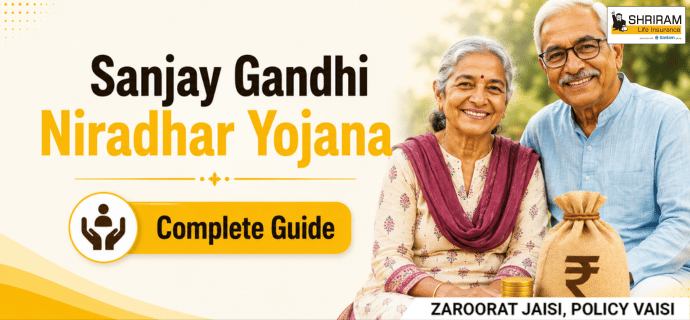
Growing old should not mean growing anxious about money. Yet for millions of elderly Indians with no savings, no pension from a job, and no steady income, that is exactly the worry that follows them every month.
The Indira Gandhi National Old Age Pension Scheme is a central government pension programme that gives a fixed monthly amount to senior citizens from families living below the poverty line. It sits inside a larger social security umbrella run by the Ministry of Rural Development, and its purpose is simple: make sure that old age, on its own, never leaves someone destitute.
This piece walks through what the scheme sets out to do, how it actually works on the ground, and why it matters — while being honest about where its limits lie. If you are looking into it for an elderly parent, or thinking ahead about your own retirement years, both angles are covered here.
Key Takeaways 1. IGNOAPS is a non-contributory pension. Beneficiaries pay nothing in — the government funds it entirely. 2. It is meant for citizens aged 60 and above who belong to Below Poverty Line (BPL) households. 3. The central pension is a base amount that most states top up, so the final monthly figure varies by state. 4. It falls under the National Social Assistance Programme (NSAP), administered by the Ministry of Rural Development. 5. Pension is paid straight into the beneficiary's bank or post office account through Direct Benefit Transfer (DBT). |
What is IGNOAPS?
Think of it as a safety floor for old age. The Indira Gandhi National Old Age Pension Scheme provides a monthly pension to poor senior citizens who have little or no reliable income of their own.
It is one of five sub-schemes under the National Social Assistance Programme, or NSAP — the government's broad social security net for vulnerable groups, which also covers widows and persons with disabilities. The old-age component was first launched in 1995 as the National Old Age Pension Scheme, then renamed and relaunched as IGNOAPS in 2007.
Here is the thing that trips people up. It is a welfare pension, not a savings or investment product. Nobody contributes to it during their working years. There is no fund building up in the background. It is direct financial assistance from the state to citizens who need it most.
Objectives of the IGNOAPD scheme
At its heart, the scheme exists to protect dignity. Old age is universal, but the ability to afford it is not. IGNOAPS was built to close that gap for the poorest.
A few clear intentions sit behind it. The first is basic income security — ensuring that elderly people in poor households have at least some money coming in every month for food, medicine, and daily needs. The second is reducing dependence. Many older Indians rely entirely on children or relatives, and a small independent income eases that pressure on both sides.
There is a quieter objective too: self-respect. Receiving a pension in one's own name, into one's own account, carries a sense of standing that charity or handouts do not. For someone who worked hard all their life, that difference is not small.
How much pension does it pay?
This is where the answer gets a little layered, so let us keep it plain.
The Central Government pays a fixed base amount, which is higher for the very elderly. On top of that, most State Governments add their own contribution — a top-up. So the total a beneficiary actually receives depends heavily on which state they live in.
A senior citizen in one state may receive a modest sum, while someone the same age in another state gets several times more. The base is national; the generosity above it is local.
WORTH KNOWING Because states set their own top-ups, the same central scheme delivers very different pensions across India — from a few hundred rupees a month in some states to a few thousand in others. Always check the current rate on your state's Social Welfare portal before applying. |
Representative structure:
Component | Who sets it | What it means for you |
|---|---|---|
Central base | Government of India | Same across the country; higher slab for those 80+ |
State top-up | Your State Government | Varies widely; some states add a large amount, some add little |
Total pension | Central + State combined | The figure that actually lands in the account each month |
Payment mode | DBT | Paid directly to a bank or post office account |
Key features of the scheme
A handful of features define how IGNOAPS behaves, and they are worth understanding before applying.
It is non-contributory. This is the big one. Unlike a provident fund or an annuity, the beneficiary never puts money in. The entire pension is funded by the government.
Pensions rise with age. The scheme recognises that the very elderly often have greater needs and fewer options, so the amount steps up once a beneficiary crosses into the older age slab.
Money reaches people directly. Payments go through Direct Benefit Transfer, straight into the beneficiary's account. That cuts out middlemen and reduces the leakage that older cash-based systems suffered from.
There is no application deadline. Eligible people can apply whenever they are ready — the scheme runs continuously, not in annual windows
Who is eligible for IGNOAPS?
The criteria are deliberately tight, because the scheme targets those most in need. Three conditions matter most.
The applicant must be 60 years or older. They must belong to a household officially classified as Below Poverty Line under government criteria. And they should have little or no regular financial support of their own. Both men and women qualify equally.
One common misconception is worth correcting. People assume every senior citizen qualifies. They do not. IGNOAPS is specifically for the BPL population — a comfortably-off retiree is not the intended beneficiary, and that is by design.
How to apply for IGNOAPS
The process runs through your local social welfare machinery, and it is more straightforward than most government paperwork suggests. In broad strokes, here is how it goes.
Start at the source. In rural areas, the application goes through the local Social Welfare Department or Gram Panchayat. In towns and cities, it is the District Social Welfare Officer.
Gather the proofs. You will typically need age proof, a BPL card or income certificate, identity and address proof such as Aadhaar, and bank or post office account details for the DBT.
Submit and verify. Once submitted, the application is scrutinised by local officers, recommended upward, and finally sanctioned by a district-level committee. You can track the status on the NSAP portal.
⚠ COMMON MISTAKE Procedures and portals differ from state to state. Applying through the wrong office, or using an out-of-state process, is the most frequent reason applications stall. Always confirm your own state's route first. |
Why the scheme matters — and where it stops short
For the households it reaches, IGNOAPS is not a small thing. A regular, predictable amount every month can mean the difference between skipping medicine and buying it, between dependence and a little breathing room. As a piece of social security, it does real work.
But let us be direct about this. It is a floor, not a plan. The scheme was built to prevent destitution among the poorest, not to fund a comfortable retirement. For anyone who is not BPL — the salaried worker, the small business owner, the middle-class family — it was never meant to be the answer, and it will not be.
That is the gap most people realise too late. A government safety net protects the most vulnerable; building a retirement you can actually live on is a separate job, and it belongs to you. This is where planning your own corpus early matters. A simple retirement corpus calculator can show how much you would need to set aside today to stay independent later, and Shriram Life retirement plans are designed to turn that saving into a steady income for your later years.
For those looking specifically at a guaranteed lifelong income, the Saral Pension annuity plan is worth exploring. And if you want the wider context on government-backed options for the elderly, the guide to the Senior Citizen Savings Scheme is a useful next read.
The bottom line
IGNOAPS does something quietly important — it makes sure the poorest Indians are not left with nothing in old age. That is worth appreciating, and worth applying for if a parent or elder in your family qualifies.
For everyone else, treat it as a reminder rather than a plan. The comfortable, independent retirement most people picture is something you build, not something you are given.
FAQs
No. It is meant only for senior citizens aged 60 and above who belong to Below Poverty Line households. A financially comfortable retiree does not qualify.
Not at all. It is a fully non-contributory scheme - the government funds the entire pension.
The central government pays a fixed base, but states add their own top-up. Since each state decides its own top-up, the total varies across the country.
Through Direct Benefit Transfer, straight into the beneficiary's bank or post office account. No cash handling is involved.
No. There is no deadline. Eligible individuals can apply at any time through their local social welfare office.
Yes. It can be stopped if the beneficiary no longer meets the criteria - for example, if their BPL status changes - or in the event of their death.
It is a government welfare pension that gives poor senior citizens a fixed monthly amount, so they have some income in old age without having to contribute anything themselves.
Apply through your local Social Welfare Department or Gram Panchayat in rural areas, or the District Social Welfare Officer in urban areas, with age proof, BPL proof, ID, and bank details.
For most people, no. It is a poverty-prevention floor for the neediest, not a full retirement income. Planning a separate corpus through savings or a pension plan is the realistic path to a comfortable retirement.
Plans worth exploring
 Shriram Life Flexi-Shield Plan
Comprehensive Protection

Shriram Life Flexi-Shield Plan  Shriram Life Sunishchit Laabh
Secure your family's future
Shriram Life Sunishchit Laabh  Shriram Life Wealth Pro Plan
Strong Returns, Steady Protection
Shriram Life Wealth Pro Plan
Why Shriram Life
Experience
Lives covered
Claims Settled (FY 2025-26)
Explore more topics
Trending searches
Find the right plan for you
OTP Verification
Please Enter OTP that has been sent to your registered
Mobile Number +91



Get a call Back to Plan Your Life Insurance
OTP Verification
Please Enter OTP that has been sent to your registered
Mobile Number +91

We’ve Got Your Details
You’re one step closer to securing a guaranteed income. Our team will contact you soon.


