


Which Deductions Are Allowed in the New Tax Regime for FY 2025–26
- Updated On:02 Mar 2026
 Views
Views- 1 min read
https://www.shriramlife.com/blog/advice/which-deductions-are-allowed-in-the-new-tax-regime


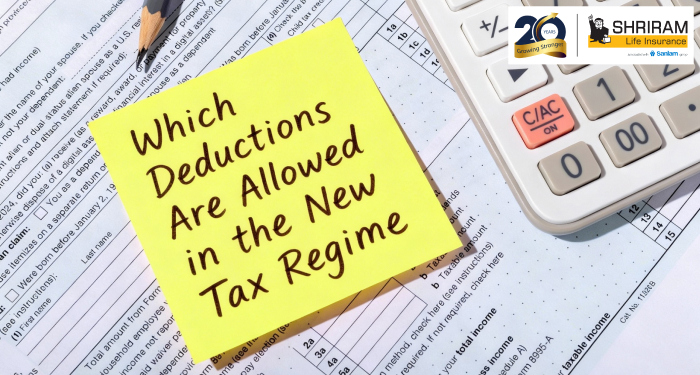
If you’re wondering which deductions are allowed in the new tax regime, the government has simplified the system by keeping only select deductions while offering lower tax rates. The idea is to make tax filing easier, with fewer exemptions and less paperwork.
Understanding Which Deductions Are Allowed in the New Tax Regime
Under the new tax regime for FY 2025–26, most traditional deductions from the old regime, such as Section 80C, 80D, and 80TTA, are not permitted. However, taxpayers can still benefit from a few key deductions that remain available.
Here’s a breakdown of which deductions are allowed in the new tax regime:
- Standard deduction: ₹75,000 for salaried individuals and pensioners.
- Employer’s contribution to NPS: Up to 14% of basic salary (for government employees) or 10% (for others).
- Interest on home loan (Section 24b): Up to ₹2 lakh for self-occupied property.
- Pension scheme contributions: Under Section 80CCD(2) and related Central Government schemes.
- Medical expenses for disabled dependents: As per Section 80DD or 80U.
- Interest on savings bank accounts: Up to ₹10,000 for non-senior citizens.
- Interest on deposits for senior citizens: Up to ₹50,000.
- Specific deductions under Sections 80JJAA and 80M (for employment generation and company dividends).
These deductions aim to balance tax benefits with simplified compliance, giving taxpayers flexibility to choose between the old and new regimes.
Know Which Deductions Are Allowed in the New Tax Regime Before You File
Understanding which deductions are allowed in the new tax regime helps you make informed decisions, optimise your tax liability, and file returns smartly without missing out on the benefits that still apply.
FAQs
Salaried individuals can claim a ₹75,000 standard deduction and the employer’s NPS contribution under the new regime.
Yes, interest up to ₹2 lakh under Section 24(b) is allowed for self-occupied property.
No, investments under Section 80C are not included in deductions which are allowed in the new tax regime.
Senior citizens can claim up to ₹50,000 interest on deposits and a standard deduction of ₹75,000.
Compare both regimes. If your eligible deductions under the old system are high, you may benefit from staying there; otherwise, the new regime’s lower rates might suit you better.
Plans worth exploring
 Shriram Life Flexi-Shield Plan
Comprehensive Protection

Shriram Life Flexi-Shield Plan  Shriram Life Sunishchit Laabh
Secure your family's future
Shriram Life Sunishchit Laabh  Shriram Life Wealth Pro Plan
Strong Returns, Steady Protection
Shriram Life Wealth Pro Plan
Why Shriram Life
Experience
Lives covered
Claims Settled (FY 2025-26)
Explore more topics
Trending searches
Find the right plan for you
OTP Verification
Please Enter OTP that has been sent to your registered
Mobile Number +91




Get a call Back to Plan Your Life Insurance
OTP Verification
Please Enter OTP that has been sent to your registered
Mobile Number +91

We’ve Got Your Details
You’re one step closer to securing a guaranteed income. Our team will contact you soon.


