


Types of Life Insurance in India: Features, Benefits and How to Choose
- Updated On:16 Nov 2026
 Views
- 10 min read
https://www.shriramlife.com/blog/life-insurance/types-of-life-insurance



 Reviewed By: Swagata Chatterjee

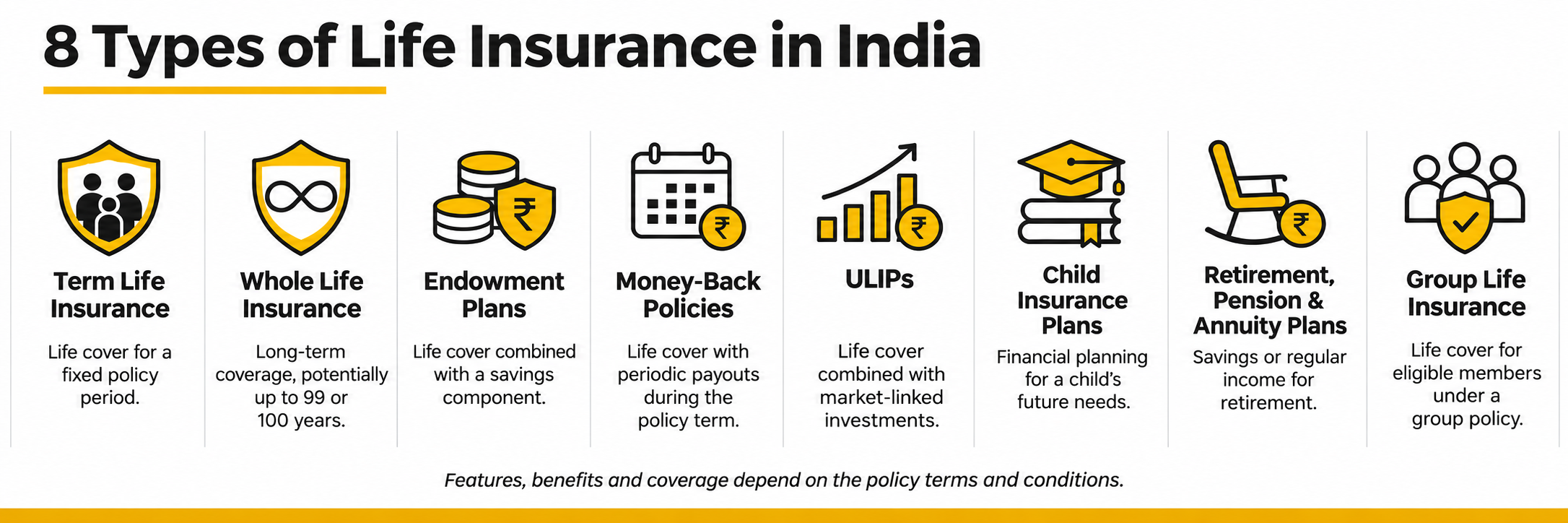
The main types of life insurance in India include term insurance, whole life insurance, endowment plans, money-back policies, ULIPs, child plans, retirement plans and group life insurance. In fact, each type generally serves a different need.
Some focus on family protection, while others combine life cover with savings, market-linked investments or retirement income. Therefore, understanding their features, benefits, as well as payout rules can help you to choose a policy that matches the needs and financial goals of your family.
What are the Main Types of Life Insurance?
The main types of life insurance might differ in how they provide you with protection, savings or income. Some pay a death benefit during the policy term, while others may also provide maturity benefits or periodic pay-outs. So you need to check the policy document to understand the exact benefits and conditions.
Do you want to know how many types of life insurance are there in India? Below, you can find a detailed guide to the key types of life insurance:
1. Term Life Insurance
Term life insurance offers life cover for a fixed period chosen by the policyholder. If the insured person passes away during this period, the nominee receives the death benefit as per the policy terms.
Features and Benefits
Below, you can find the features of term life insurance that can empower you and elevate your experience:
- Financial Protection: Your family might use the death benefit to manage their household expenses, repay loans and meet their future financial needs.
- Premium Payment: You can usually pay your premiums monthly, quarterly, half-yearly or annually, depending on available payment options.
For example, if you choose term insurance with ₹50 lakh cover, Your nominee receives ₹50 lakh if death occurs during the term and the policy is in force.
2. Whole Life Insurance
This type of life insurance policy provides long-term coverage, which may extend up to 99 or 100 years of age, depending on the policy. It offers financial protection to your beneficiaries for an extended period, subject to the policy conditions.
Features and Benefits
Here you can find the key features of Whole life insurance and how they benefit you:
- Long-Term Cover: You can normally provide your financial support to your family later in life through a death benefit.
Premium Options: You may need to pay your premiums throughout your policy term or over a limited period, depending on your selected plan.
For example, if you purchase a whole life insurance policy at the age of 35 with coverage up to 100 years, your nominee may receive the death benefit if you pass away during the coverage period, provided the policy conditions are met.
3. Endowment Plans
Endowment plans normally combine your life cover with a savings component. Additionally, you may receive a death benefit during your policy term or maturity benefits if you survive until the policy tenure.
Features and Benefits
Some benefits and features of endowment plans are:
- Life Cover and Savings: You can maintain your life cover while you are building savings for your future financial goals.
Maturity Benefit: You might receive a maturity payout after completing your policy term, according to its benefits as well as conditions.
For example, if you choose a 15-year endowment plan, Maturity is paid on survival of the life insured to the end of the term, with all premiums paid.
4. Money-Back Policies
A money-back policy provides life insurance coverage along with periodic payouts during the policy term. You receive a portion of the sum assured at specified intervals, with the remaining benefits paid as per the policy terms.
Features and Benefits
Discover how money-back policies work and the ways they protect the financial future of your family:
- Periodic Payouts: You can receive your scheduled payments during your policy term to help manage your planned expenses.
- Maturity Payout: You may receive your additional benefits at maturity, depending on your policy terms as well as your eligibility.
For example, if your policy offers 20% of a ₹10 lakh sum assured at an eligible payout stage, you may receive ₹2 lakh, subject to your policy terms.
5. Unit Linked Insurance Plans (ULIPs)
This life insurance type, a part of the premium goes towards providing life insurance coverage, while the remaining amount is invested in funds of your choice. The value of your investment depends on the performance of the selected funds and market conditions.
Features and Benefits
Some benefits and features of ULIPs are as follows:
- Life Cover and Investment: You can maintain your life cover while you are investing in funds linked to market performance.
Lock-in Period and Charges: ULIPs have a mandatory five-year lock-in period. So you need to check your applicable charges and withdrawal conditions before choosing a plan.
For example, if you need to pay ₹60,000 annually towards a ULIP, part of your premium may go into selected funds after applicable charges, and market movements can change its value.
6. Child Insurance Plans
It helps you to prepare financially for your future expenses, such as education fees. In fact, depending on your chosen plan, benefits might include your life cover, savings and scheduled payouts.
Features and Benefits
Here you can learn how child insurance plans work to protect your family's financial future:
- Goal-Based Savings: You can mostly build your savings for your future expenses, including college fees and professional courses.
- Premium Waiver: Some plans waive future premiums if an insured parent faces an unfortunate event, allowing benefits to continue under policy conditions.
For example, if you want to save ₹8 lakh for the education of your child, you need to compare plans with your payout dates that match your expected education expenses.
7. Retirement, Pension and Annuity Plans
Retirement, pension and annuity plans can help you build savings for your post-retirement years. Depending on the policy, you may receive a lump sum or a regular income to manage expenses after retirement.
Features and Benefits
Some key features and benefits of this plan are:
- Retirement Corpus: With these types of life insurance, you can build your retirement fund through regular or single premiums, depending on your selected plan.
- Payout Options: You might need to choose between immediate and deferred income, depending on available options, annuity terms, as well as eligibility.
For example, if you use ₹20 lakh to purchase an annuity at age 60, your regular income will depend on its rate and selected payout option.
8. Group Life Insurance
This covers multiple eligible people like you under one master policy. Furthermore, employers, organisations or associations might arrange to cover employees or members under your agreed policy conditions.
Features and Benefits
Do you want to know: “What are the benefits of group life insurance?” Below you can find the answer with its features:
- Group-Based Cover: You can usually receive your life cover through an eligible group, with benefits depending on your policy terms.
- Convenient Access: Your employer or group administrator may manage enrolment, although eligibility as well as your underwriting requirements can vary.
For example, if your employer provides ₹5 lakh group life cover, your nominee might receive this amount if you face an unfortunate incident while covered, subject to policy conditions.
Are you looking for the right life cover? Shriram Life Insurance offers protection, savings, investment and retirement options. So take a moment to compare your options and check each policy's conditions before choosing cover.
Comparison of Different Types of Life Insurance
Each life insurance type naturally serves a different financial purpose. So you need to compare your coverage duration, maturity benefits, investment exposure and payout patterns before making a decision.
| Type of Life Insurance | Purpose | Coverage Duration | Maturity Benefit | Investment exposure | Payout Pattern | Key Considerations |
| Term life insurance | Family protection as well as income replacement | Your fixed chosen policy term | Usually none in regular plans | No direct market-linked investment | Death benefit during your covered term | Affordable cover; you can check exclusions |
| Whole life insurance | Long-term or lifelong family protection | Your lifetime or defined maximum age | Depends on your product terms | Cash value may be available in some plans | Death benefit under your policy terms | Premium structure and cover duration
|
| Endowment Plans | Life cover with your planned savings | Fixed policy term | Available under eligible plans | Generally not directly market-linked | Death or maturity benefit | Check guaranteed benefits and applicable bonus conditions |
| Money-back policies | Protection with periodic payouts | Fixed policy term | Periodic survival benefits and a final maturity benefit | Mainly depends on product structure | Survival payments and death benefit | Review payout dates and conditions |
| ULIPs | Life cover with market-linked investment | Product-defined policy term | Fund value under policy terms | Direct market-linked fund exposure | Death or maturity benefits | Five-year lock-in; charges and market risk |
| Child insurance plans | Your child's future financial goals | Selected long-term policy term | Typically depends on policy structure | Depends on product | Scheduled payouts or maturity benefit
| Check your premium-waiver conditions
|
| Retirement and annuity plans | Retirement savings or income | Product-dependent | Depends on your plan type | Depends on the selected product | Retirement corpus or periodic annuity income | Review your income options and guarantees |
| Group life insurance | Cover for eligible group members
| As defined by group policy | Usually not applicable to pure group term plans
| Generally no direct investment feature | Death benefit under group terms | Check your eligibility and cover continuation |
How Different Types of Life Insurance Helps Meet Financial Needs?
Different types of life insurance are designed to meet your various financial needs. So understanding your responsibilities can mainly help you to identify the type of cover that fits your needs.
1. Family Protection
Family protection plans normally help your dependents to manage their expenses if an insured person faces an unfortunate event during the policy term. Besides, the payout might support your household costs, children's needs and other financial commitments.
For example, suppose you earn ₹12 lakh annually and support your three family members. In this case, a suitable life cover could help your family to manage expenses if your income stops unexpectedly.
2. Loans and Financial Liabilities
Your home loans, personal loans and other debts can create financial pressure for your family. In that case, life insurance can help your nominee to manage their eligible liabilities when you face any kind of unfortunate event. However, it might sometimes depend on the type of life insurance plan.
For example, suppose you have a home loan balance of ₹35 lakh and other family expenses. So your life cover should consider both your liabilities and future living costs.
3. Savings and Long-Term Goals
Some life insurance policies might combine life cover with a savings feature. Besides, they may help policyholders to plan for their future expenses, such as buying a house, funding higher education or meeting their other long-term goals. The benefits and returns mainly depend on the types of life insurance plans.
For example, suppose you want to build your funds for a goal 15 years away. A suitable savings plan may help you to follow a structured payment schedule while you provide life cover.
4. Child Education and Retirement Needs
Parents might need money for school fees, higher education, as well as expenses on extracurricular activities as their children grow. Therefore, people who are planning for their retirement may also need to build a corpus that can normally support their expenses after regular employment income stops.
For example, your child will start college in 12 years. In this case, you need to estimate your future education costs and compare plans with suitable terms and payout schedules.
How to Choose the Right Type of Life Insurance?
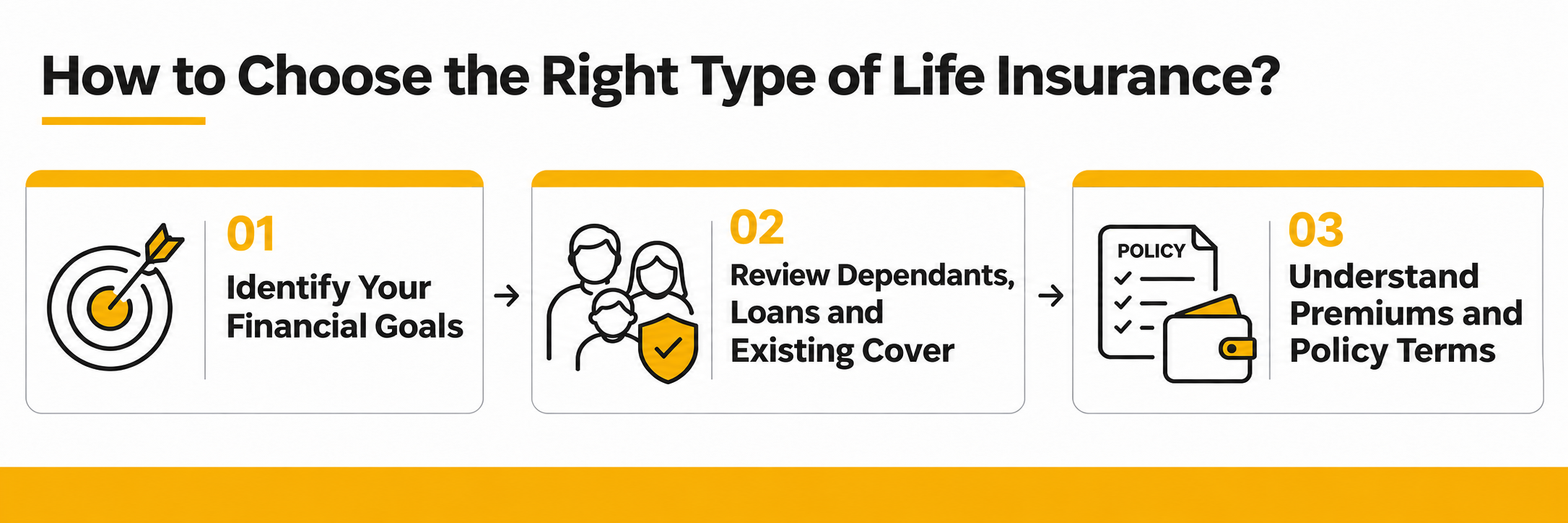
To choose the right type of life insurance in India, you need to follow some points. Below, you can get a detailed view of those points:
1. Identify Your Financial Goals
Your financial goals should guide your choice. So a family with young children may prioritise protection, while someone nearing retirement may need regular income.
For example, a 30-year-old parent with a home loan may prioritise life protection. But someone aged 55 with sufficient savings may instead compare retirement-income options.
2. Review Dependants, Loans and Existing Cover
Your life cover should reflect the financial needs of your family. So you need to consider outstanding loans, future education costs, daily expenses and existing insurance.
However, according to The Economic Times , policies with cover above ₹50 lakh rose from 4.4 million in FY2021 to 7.4 million in FY2025. This growth shows a clear shift towards enhanced insurance protection as well as higher coverage levels among policyholders
3. Understand Premiums and Policy Terms
You can normally choose a premium that you can manage throughout the required payment period. However, always read the contract before making a commitment.
For example, suppose a policy offers 20 years of cover but requires premiums for only 10 years. So you need to check the payment schedule and conditions before selecting it.
In short, you need to choose a life insurance plan that matches your family's needs, financial goals and budget. According to The Economic Times, the life insurance industry in India has recorded a 16% increase in new business premiums during FY2026.
It shows a shift toward high-margin protection and long-term savings products, and a rising demand for regular premium policies. So you need to compare protection, savings, investment and retirement options carefully.
Shriram Life Insurance offers protection, savings, investment, and retirement plans. Compare options and read policy terms carefully before choosing your coverage. The right types of life insurance can support your financial planning when you understand the benefits and limits of each policy.
Disclaimer
Insurance is the subject matter of solicitation. For complete details of benefits, exclusions, limitations, charges, terms and conditions, please refer to the sales brochure and policy document carefully before concluding a sale
Source Links:
- https://agencyportal.irdai.gov.in/
- https://www.moneycontrol.com/news/business/personal-finance/should-you-withdraw-your-ulip-after-the-5-year-lock-in-here-s-how-to-make-the-right-choice-13994189.html
Plans worth exploring
 Shriram Life Flexi-Shield Plan
Comprehensive Protection

Shriram Life Flexi-Shield Plan  Shriram Life Sunishchit Laabh
Secure your family's future
Shriram Life Sunishchit Laabh  Shriram Life Wealth Pro Plan
Strong Returns, Steady Protection
Shriram Life Wealth Pro Plan



Why Shriram Life
Experience
Lives covered
Claims Settled (FY 2025-26)
Explore more topics
Trending searches
Find the right plan for you
OTP Verification
Please Enter OTP that has been sent to your registered
Mobile Number +91




Get a call Back to Plan Your Life Insurance
OTP Verification
Please Enter OTP that has been sent to your registered
Mobile Number +91

We’ve Got Your Details
You’re one step closer to securing a guaranteed income. Our team will contact you soon.


