


Income Tax Slabs in India: Old and New Tax Regime
- Updated On:24 Nov 2026
 Views
- 10 min read
https://www.shriramlife.com/blog/tax-planning/income-tax-slabs


 Reviewed By: Anand Soni

- Income Tax Slabs in India for Tax Year 2026–27
- How is Slab Rate Different from Effective Tax Rate?
- What Are Income Tax Slabs?
- Old Tax Regime vs New Tax Regime
- Income Tax Rebate, Standard Deduction, Cess and Surcharge
- 8. Standard Deduction for Salaried Individuals and Pensioners
- How to Calculate Income Tax in India?
- Which Tax Regime Should You Choose?
- Use the Income Tax Calculator
- Key Takeaways
- Sources
The income tax slabs in India classify income into various bands where each band is taxable at the applicable slab rate. In Tax Year 2026-27, the rate depends on whether you opt for the old or new regime.
Quick answer: For the new regime, 0% to 30% on all income tax slab rates in India ranging from 0% (NIL) upto ₹4 lakh to 30% on income above ₹24 lakh. For the old regime, the slab rates are between 0%-30%, with different thresholds, including age-specific exemptions for resident senior citizens.
Income Tax Slabs in India for Tax Year 2026–27
For Tax Year (TY) 2026-27, which is April 1, 2026 to March 31, 2027, individual taxpayers in India are generally allowed to compute their income tax under either the old tax regime or the new tax regime. This depends on the applicable eligibility and option rules. The new tax regime slabs will be the default.
Those who meet the conditions can opt for the old regime. Below are the tables which apply to individual taxpayers who meet the conditions and whose income is taxable at normal income tax slab rates. There are some capital gains, lottery winnings, and other income which are taxable at special rates.
The rates below are basic income tax rates in India, without rebate, surcharge and health and education cess applicable:
1. Old Income Tax Regime for 2026-27
The table below brings out the relevant income tax rates for individuals under the age of 60 years in relation to the old tax system for 2026-27:
| Taxable income range | Applicable tax rates |
| Up to ₹2,50,000 | NIL |
| ₹2,50,001 to ₹5,00,000 | 5% above ₹2,50,000 |
| ₹5,00,001 to ₹10,00,000 | ₹12,500 + 20% above ₹5,00,000 |
| Above ₹10,00,000 | ₹1,12,500 + 30% above ₹10,00,000 |
Source - https://www.incometax.gov.in/iec/foportal/help/individual/return-applicable-1
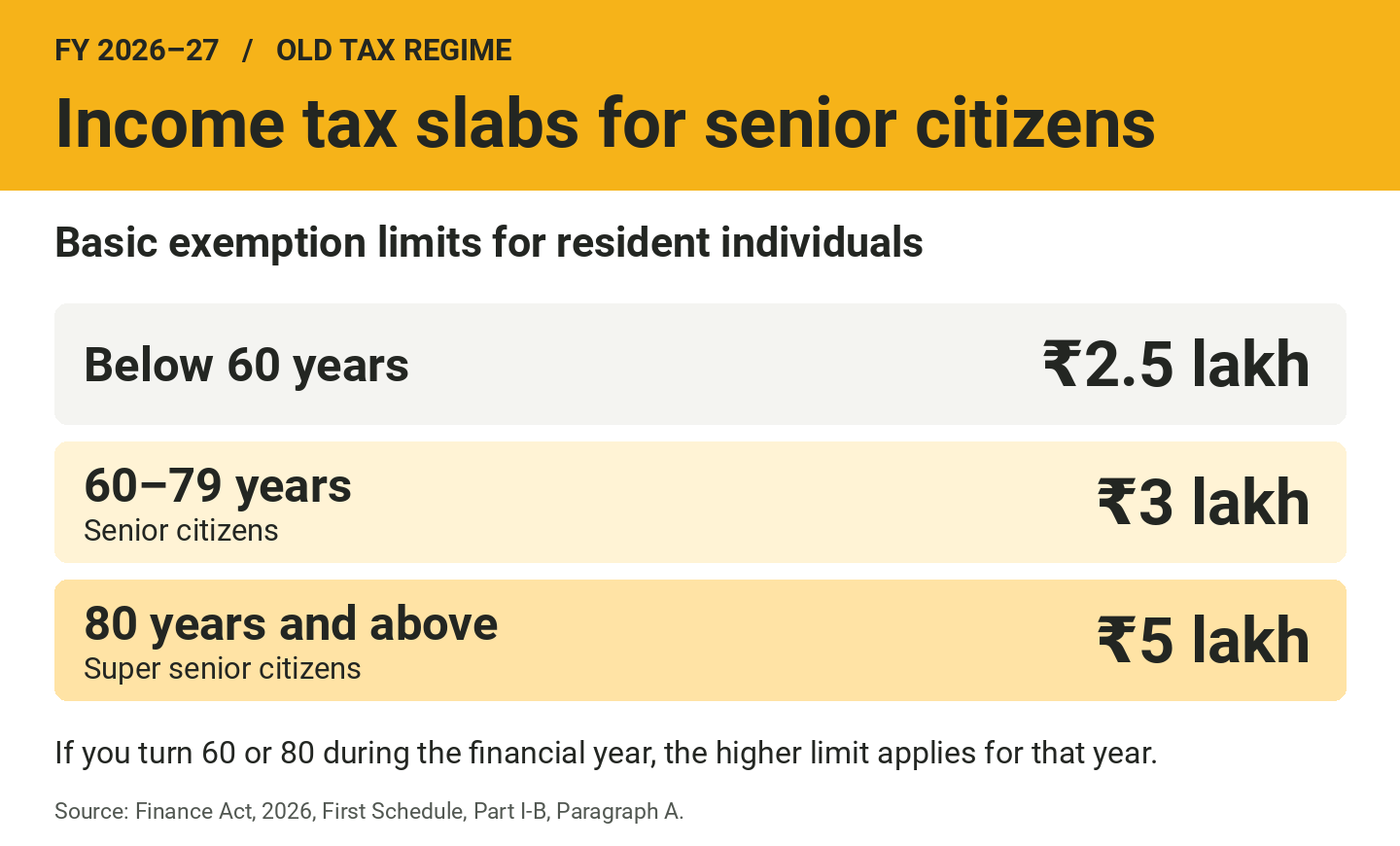
2. Age-Based Exemption Limits for Resident Individuals
The variations that arise in relation to the old tax system include:
| Taxpayer category | Basic exemption limit |
| Resident individual below 60 years | ₹2,50,000 |
| Resident senior citizen (60–79 years) | ₹3,00,000 |
| Resident super-senior citizen (80 years or above) | ₹5,00,000 |
For senior citizens, the relevant rates are:
| Taxable income range | Resident senior citizen (60–79) | Resident super-senior citizen (80+) |
| Up to ₹3 lakh or ₹5 lakh respectively | NIL | NIL |
| ₹3 lakh to ₹5 lakh | 5% | NIL |
| ₹5 lakh to ₹10 lakh | ₹10,000 + 20% above ₹5,00,000 | 20% above ₹5,00,000 |
| Above ₹10 lakh | ₹1,10,000 + 30% above ₹10,00,000 | ₹1,00,000 + 30% above ₹10,00,000 |
The non-resident Indians (NRIs) do not get the benefit of age-specific exemption in relation to the old tax system. The reason is that their basic exemption will always be ₹2.5 lakh irrespective of whether the person is 60 years or 80 years of age.
3. New Income Tax Regime for 2026-27
The tax system introduced in Section 202 of the Income Tax Act 2025 provides a set of income tax slabs for people eligible to apply under the new regime without any consideration of their age or residence.
Let us examine what are the applicable tax rates under the new income tax regime for the Tax year 2026-27:
| Taxable income range | Applicable tax rates |
| Up to ₹4,00,000 | NIL |
| ₹4,00,001 to ₹8,00,000 | 5% above ₹ 4,00,000 |
| ₹8,00,001 to ₹12,00,000 | ₹20,000 + 10% above ₹8,00,000 |
| ₹12,00,001 to ₹16,00,000 | ₹60,000 + 15% above ₹12,00,000 |
| ₹16,00,001 to ₹20,00,000 | ₹1,20,000 + 20% above ₹16,00,000 |
| ₹20,00,001 to ₹24,00,000 | ₹2,00,000 + 25% above ₹20,00,000 |
| Above ₹24,00,000 | ₹3,00,000 + 30% above ₹24,00,000 |
The new regime is the standard tax regime. Individual taxpayers who are eligible and want to apply to the old regime should elect the option provided in the Income Tax Act 2025. Generally, the new regime will be more beneficial in terms of slab rates. However, there will be limited exemptions and deductions compared to the old one.
How is Slab Rate Different from Effective Tax Rate?
A slab rate is the rate of tax charged on a certain part of income that falls in that particular income bracket. The effective tax rate is the rate of the total amount of income taxed, considering the tax charged at different income tax slabs in India.
Applying to a high tax slab does not mean that all the income of the taxpayer is taxed at that rate; only the income that falls in that particular slab is taxable.
What Are Income Tax Slabs?

The tax system adopted by India is based on a slab and progressive tax structure. This means that there will be different rates for different segments of the total income. In other words, the income is split into several categories, which are referred to as tax slabs.
Every slab is allocated a certain tax rate, and income in the form of such a slab is taxed according to the relevant tax rate. According to DD News, for the Assessment Year 2026-27, over 7.8 crore Income Tax Returns (ITRs) were filed in India.
A progressive tax system implies an increasing tax rate in case of an increase in taxable income level. This idea is associated with the marginal tax rate. The latter implies a rate applicable to extra income allocated within a specific tax slab and not necessarily all income of the taxpayer.
Illustrative Example
Suppose the following simplified tax slabs apply whose age is below 60 years for the FY 2026-27 in old tax regime:
| Income range | Tax rate |
| Up to ₹2.5 lakh | 0% |
| ₹2.5 lakh to ₹5 lakh | 5% |
| ₹5 lakh–₹10 lakh | 20% |
| Above ₹10 lakh | 30% |
When a person's taxable income is greater than ₹11 lakh, the computation will be as follows:
| Income portion | Tax rate | Tax payable |
| First ₹2.5 lakh | 0% | ₹0 |
| ₹2.5 lakh to ₹5 lakh | 5% | ₹12,500 |
| Next ₹5 lakh | 20% | ₹ 1,00,000 |
| Remaining ₹1 lakh | 30% | ₹ ₹30,000 |
| Total tax | ₹1,42,500 |
In this case, although the income of the individual is above ₹10 lakh, the tax slab of 30% applies to the extra ₹1 lakh.
Old Tax Regime vs New Tax Regime
There are differences in India's old and new taxation systems regarding the rates of tax, deductions, and exemptions. Neither is superior to the other; suitability depends on the taxpayer's personal circumstances.
| Parameters | Old Tax Regime | New Tax Regime |
| Slab structure | For individuals below 60: NIL up to ₹2.5 lakh; 5% from ₹2.5–5 lakh; 20% from ₹5–10 lakh; 30% above ₹10 lakh. Senior citizens have higher basic exemption limits. | NIL up to ₹4 lakh; 5% from ₹4–8 lakh; 10% from ₹8–12 lakh; 15% from ₹12–16 lakh; 20% from ₹16–20 lakh; 25% from ₹20–24 lakh; 30% above ₹24 lakh. |
| Deductions and exemptions | Section 80C eligible investments, health insurance under Section 80D, HRA and some home loan interest deductions. | Not available; however, certain exclusions still apply, such as eligible employer contribution to NPS and others. |
| Standard deduction | Available to eligible salaried individuals and pensioners, generally up to ₹50,000. | Eligible salaried individuals and pensioners can get a maximum of ₹75,000. |
| Rebate conditions | Resident individuals with taxable income up to ₹5 lakh may be eligible for a rebate of up to ₹12,500 under section 87A. | Resident individuals having taxable income of up to ₹12 lakh can avail a rebate of up to ₹60,000 subject to certain conditions and exclusions for special income. |
| Regime selection and opt-out | This is the optional regime. | This is the default tax regime. The eligible taxpayer has an option to opt out and choose the old regime, as per regulations. |
| Key considerations | It would be helpful for those people who are entitled to several deductions and exemptions. | It might help those who need lower slab rates and have fewer deductions. |
Note: The tax rates mentioned above are basic slab rates and do not include applicable surcharge and 4% health and education cess. The actual tax liability may vary depending on eligible deductions, exemptions, rebates and special-rate income.
Additional restrictions apply to those with business or professional income, who may be required to submit the required opt-out form, under the relevant provisions. They might not be able to switch back either. Before you decide, check the tax law for the current year, the form that applies and the deadline for filing.
As you prepare to implement your financial plan in the tax system, you could also buy life insurance from Shriram Life to help build a future for your family members.
Income Tax Rebate, Standard Deduction, Cess and Surcharge
These terms are very common when it comes to understanding income tax slabs in India. Let us explore each of them along with their rates:
1. Tax Deduction
Deduction is the amount deducted from gross income or income as per the particular tax head to derive taxable income. Deductions reduce the amount of income against which income tax is computed.
2. Tax Exemption
Exemption is income or a specified part thereof that qualifies for exemption from tax as per relevant laws.
3. Tax Rebate
Rebate results in an amount of reduction of income tax liability after determining the tax liability.
One significant rebate is the rebate available under section 87A of the Income-tax Act, 1961, for the previous assessment year regime. Under the new Income-tax Act, 2025, it will be under section 156.
4. Health and Education Cess
The health and education cess is an extra charge levied as a certain percentage of the income tax chargeable. For an individual, it is charged at the rate of 4%. It is levied after income tax and surcharge.
5. Surcharge
It is an additional tax imposed on income tax payable by persons whose total income exceeds a particular high-income bracket. The tax is imposed as a certain percentage of the income tax payable and not the total income.
6. Section 156 (Section 87A): Eligibility and Limits
For Tax Year 2026-27, the rebate provisions will have to be covered separately under both income tax systems. The relevant provision in this case is Section 156 of the Income Tax Act 2025.
| Particulars | New tax regime | Old tax regime |
| Maximum taxable-income threshold | ₹12,00,000 | ₹5,00,000 |
| Maximum rebate | ₹60,000 | ₹12,500 |
| Eligible taxpayers | Resident individuals | Resident individuals |
Important eligibility conditions:
- The rebate can be claimed only by Indian residents. It cannot be claimed by non-residents.
- Further, it should be noted that the rebate is never greater than the tax liability.
7. Marginal Relief Under Section 156 (87A)
The marginal relief provided under Section 156 of the Income Tax Act, 2025 ensures that there is no excessive burden of tax imposed on the taxpayer right after exceeding the threshold income of ₹12 lakh.
For example, an Indian resident has an income of ₹12.5 lakh. In case the income tax calculated is higher than the additional income above ₹12 lakh, margin relief ensures that the excess tax does not exceed the additional income.
Note: The threshold income of ₹12 lakh is not a change in the income tax slabs but only for calculating the rebate.
8. Standard Deduction for Salaried Individuals and Pensioners
Salaries and pensions are eligible to claim the standard deduction, which is a flat deduction amount. The same is deducted from the salary or pension earnings to ascertain the income chargeable to tax. In comparison to deductions from investment or spending, this does not require proof of spending.
It will depend upon the extent of salary and pension earnings qualified for such a purpose.
For instance, an employee who earns ₹12 lakh in a year under the new system can normally get a standard deduction of ₹75,000. This brings down the total taxable salary income to ₹11.25 lakh.
Additionally, you can explore financial calculators for a broader financial assessment beyond just income tax.
How to Calculate Income Tax in India?
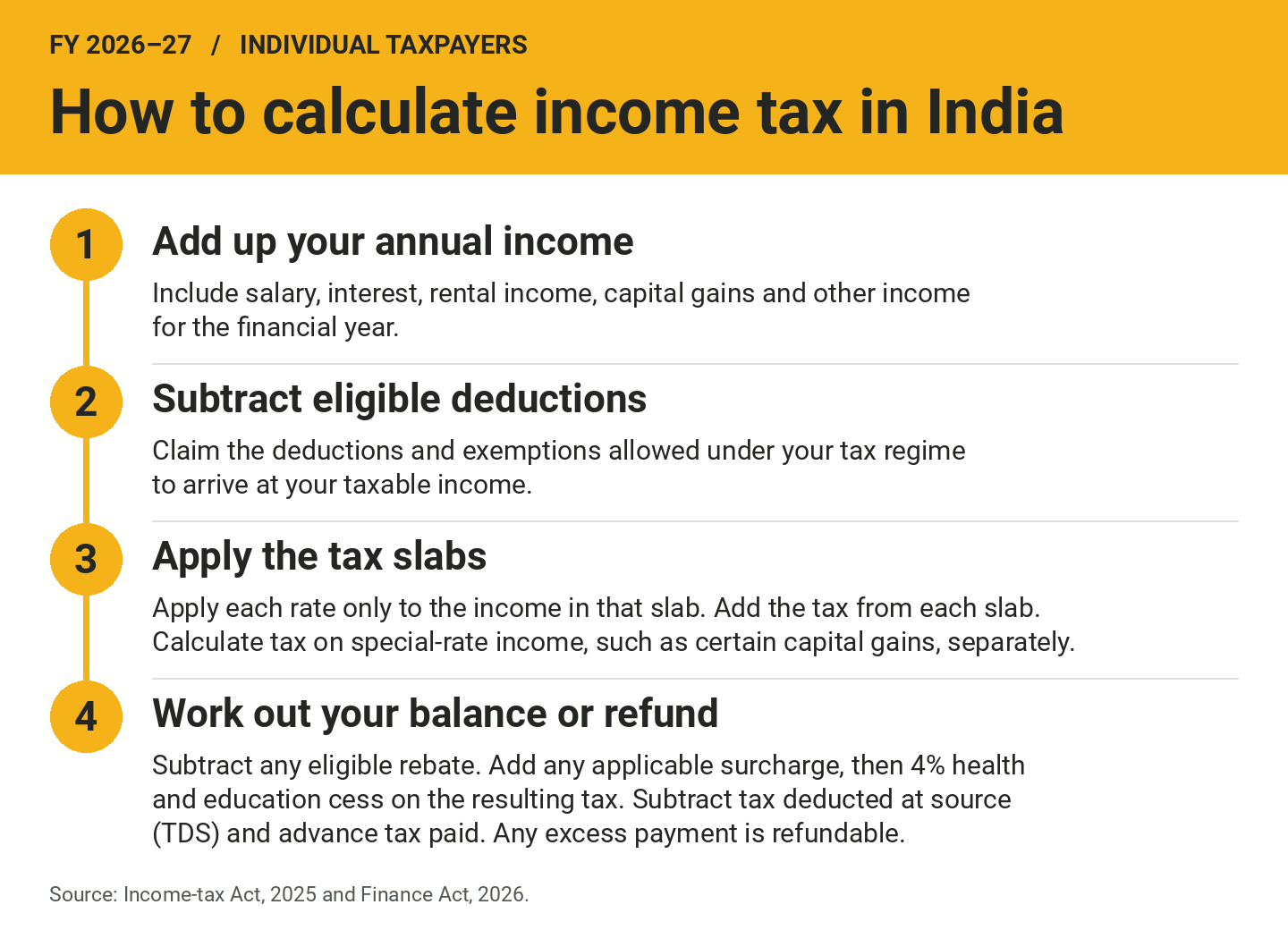
In India, you can calculate income tax by following the steps below:
- Determine the gross total income from salary, house property, business or profession, Other sources and capital gains.
- Identify which deductions or exemptions are available under the tax system you have chosen and calculate your taxable income as per the latest tax laws.
- Use slab rates and provide for rebates, surcharge, and 4% health and education cess.
- Subtract the tax liability for Tax Deducted at Source (TDS), advance tax, and other tax deductions from that to arrive at the net payable amount or net refund.
To estimate tax savings on house rent allowance, you can use HRA calculator.
Which Tax Regime Should You Choose?
To choose between the old and new tax regimes, you should compare the tax liability under both regimes using the same income details and assumptions.
Those who can claim substantial deductions like interest on home loans or eligible investments that allow for saving on taxes may find it important to evaluate both sides of the equation before choosing one.
Moreover, which regime is better depends on your circumstances and the tax rules that apply in the relevant financial year.
Use the Income Tax Calculator
You can easily calculate your income tax liability under the old and the new regime by using the Shriram Life income tax calculator tool. Enter details like your age, basic salary (per annum), HRA, rent, your eligible investments and interest on loans to get an estimate.
Enter correct inputs and compare the amount of tax that will be payable by you under both the old and the new regime and get clarity on the deductions and exemptions applicable.
Key Takeaways
|
Sources
- https://www.incometax.gov.in/iec/foportal/help/individual/return-applicable-1
- https://wm.incometaxindia.gov.in/w/tax-rates-and-computation
- https://wm.incometaxindia.gov.in/w/computation-of-tax-for-individual-1
- https://wm.incometaxindia.gov.in/web/guest/w/section-202-76
- https://www.incometaxindia.gov.in/income-from-pension
- https://www.incometax.gov.in/iec/foportal/help/new-tax-vs-old-tax-regime-faqs?mobile-app=1%2Fe-Campaigns%2Fe-mail%2Fhelp%2Fhow-to-manage-itdrein%2Fhelp%2Fhow-to-use-e-filing-dashboard-worklist%2Fhelp%2Fhow-to-use-e-filing-dashboard-worklist%2Fhelp%2Fhow-to-perform-rectification%2Flatest-news%2Fhelp%2
- https://www.indiabudget.gov.in/doc/memo.pdf
- https://ddnews.gov.in/en/over-7-8-crore-itrs-filed-for-ay-2026-27-by-august-31-income-tax-department/
Disclaimer
Insurance is the subject matter of solicitation. For complete details of benefits, exclusions, limitations, charges, terms and conditions, please refer to the sales brochure and policy document carefully before concluding a sale.
FAQs
The new tax regime is the default tax regime for individuals, HUF, AOPs, BOIs, and artificial juridical persons. It is based on the amendments made to Section 115BAC of the Income Tax Act,1961
Yes, income tax slabs in India are different for senior citizens and super senior citizens. However, this is applicable under the old tax regime slabs.
Yes, the standard deduction is available under both the new and the old income tax regimes. Although the amounts differ, both salaried employees and pensioners can avail this.
No, crossing any of the income tax slabs does not mean that you will be charged the income of the slab at the higher rate. This follows a progressive tax system. Different portions of income are taxed under different slab rates.
Calculating the income tax on your salary is easy, and you can use the Income Tax Calculator for the same. Besides this, you can also compute it by calculating the gross salary, deducting exempt allowances, deducting the standard deduction, applying the income tax slabs in India, and adding cess and rebates.
Yes, it is possible to change your tax regime every year only if you are a salaried or non-business taxpayer. You can toggle back and forth between the old and new tax regimes every year when filing an income tax return, regardless of what you informed your employer before.
Go to the e-Filing portal of the Income Tax Department and go to 'Quick Links' to choose ‘Income Tax calculator’. You can then check your income and tax under both old and new tax regimes.
The Income-tax Act, 1961 came to an end on April 1, 2026, and was replaced by the Income-tax Act, 2025. This is a significant event in the direct taxation structure of India. The Act aims to bring transparency and reduce the compliance burden on individuals and companies.
Under the Income Tax Act, 2025, Fiscal year/Tax year is the financial year or the 12 months beginning on.
No, the Tax Year 2026–27 is not the same as AY 2026–27. AY 2026-27 is the income you earn during the financial year 2025-26. Conversely, the tax year 2026-27 relates to the income you earn during FY2026-27.
Income earned in the financial year 2025-26 is governed by the Income Tax Act, 1961.
The new regime under the Income Tax Act, 2025 is stated under Section 202 of the Income Tax Act.
Plans worth exploring
 Shriram Life Flexi-Shield Plan
Comprehensive Protection

Shriram Life Flexi-Shield Plan  Shriram Life Sunishchit Laabh
Secure your family's future
Shriram Life Sunishchit Laabh  Shriram Life Wealth Pro Plan
Strong Returns, Steady Protection
Shriram Life Wealth Pro Plan
People also read
Why Shriram Life
Experience
Lives covered
Claims Settled (FY 2025-26)
Explore more topics
Trending searches
Find the right plan for you
OTP Verification
Please Enter OTP that has been sent to your registered
Mobile Number +91

Get a call Back to Plan Your Life Insurance
OTP Verification
Please Enter OTP that has been sent to your registered
Mobile Number +91

We’ve Got Your Details
You’re one step closer to securing a guaranteed income. Our team will contact you soon.


